In a nutshell
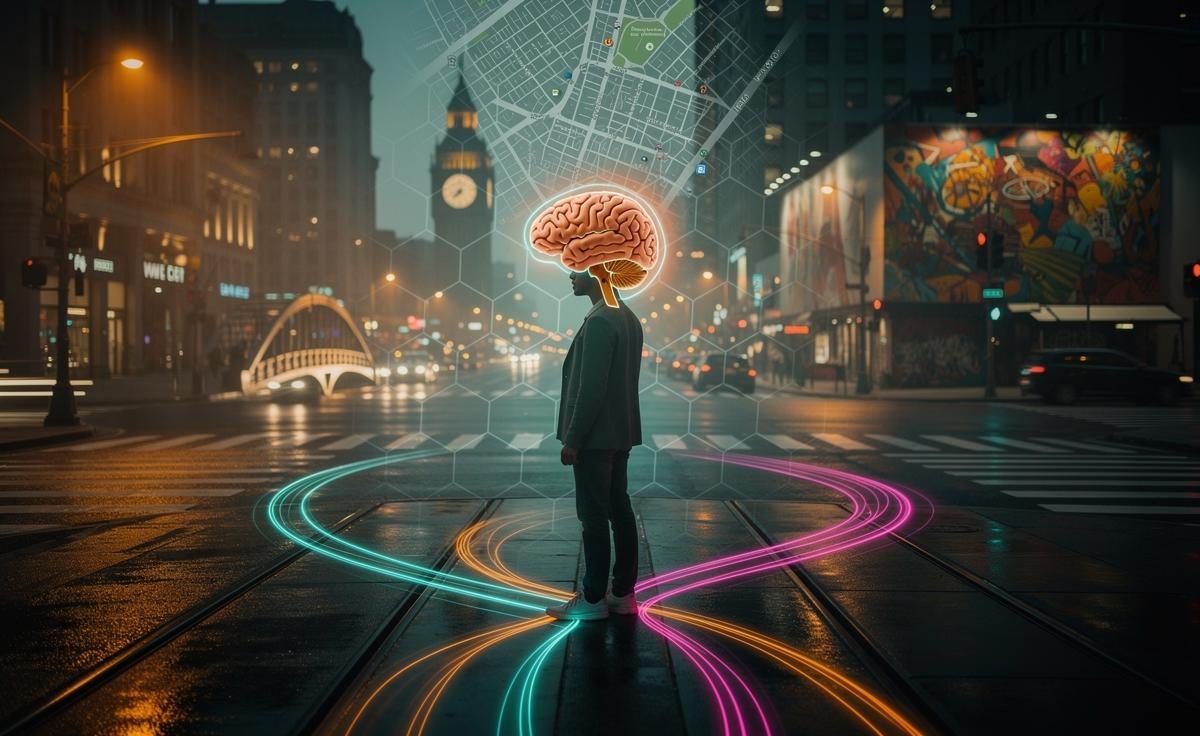
- 🧭 The brain’s navigation network—hippocampus (place cells), entorhinal cortex (grid cells), and head-direction systems—supports both allocentric (map-like) and egocentric (turn-by-turn) strategies, and flexible switching underpins strong directional memory.
- 🧬 Individual differences reflect strategy choice, moderate genetic influences, and rich experience; London taxi drivers mastering “The Knowledge” show posterior hippocampal growth, while hiking and 3D games sharpen spatial updating.
- 🗺️ Landmarks vs cognitive maps isn’t either/or: landmarks speed recognition, maps enable detours; the best navigators blend both, with the prefrontal cortex arbitrating when the unexpected appears.
- 📱 Tools and training matter: heavy GPS dependence can blunt incidental learning, whereas orienteering, active VR exploration, and “landmark labelling” strengthen survey knowledge and hippocampal memory.
- 💡 Practical and clinical takeaways: start with a map overview, name distinctive features, and sometimes navigate without prompts; spatial tasks may flag early changes in entorhinal coding, and regular navigation helps keep hippocampal systems fit.
Some of us can glance at a skyline once and weave back through side streets as if an invisible string led the way; others lose the thread as soon as the high street bends. That discrepancy isn’t just down to practice or bravado. It’s rooted in how our brains build and update internal maps. From London cabbies mastering “The Knowledge” to hikers who instinctively triangulate sun, slope, and smell, research shows that navigation prowess reflects a lively conversation between memory systems, sensation, and strategy. Understanding who remembers directions—and why—opens a window onto how the brain itself is laid out. Here’s what the science says, and how it translates to real streets and screens.
The Brain’s Navigation Network: Place, Grid, and Head-Direction Cells
At the heart of human wayfinding is a coalition of brain regions that stitch together scenes, routes, and bearings. The hippocampus encodes “where you are” using place cells, first identified by John O’Keefe at UCL, while the adjacent entorhinal cortex hosts grid cells that fire in a hexagonal pattern to provide a kind of internal graph paper. Add head-direction cells (a neural compass), the retrosplenial cortex (linking viewpoints and contexts), the parietal cortex (updating position relative to the body), and the prefrontal cortex (planning and decision-making), and you have a robust navigation network.
Crucially, there are two complementary modes: allocentric mapping (world-centred “cognitive maps” anchored to landmarks and layouts) and egocentric mapping (self-centred, turn-by-turn routines). The caudate nucleus supports habitual route learning, explaining why some people can follow the same commute flawlessly yet struggle off-route. Vestibular signals from the inner ear and visual motion cues further stabilise these maps. When people “naturally” remember directions, they’re often better at integrating these signals quickly and switching flexibly between map-like and route-like strategies as environments change.
Why Some People Excel: Strategy, Genes, and Experience
Individual differences arise from a mix of strategy choice, neurobiology, and experience. Research using the Santa Barbara Sense of Direction scale finds that high performers tend to favour allocentric strategies—forming survey-like mental maps—while also noting and naming distinctive landmarks. Twin studies suggest a moderate heritable component to sense of direction, likely reflecting how efficiently the hippocampal–entorhinal circuit builds spatial representations. Yet experience can be decisive. London’s taxi training, “The Knowledge,” is associated with structural changes in the posterior hippocampus and richer route repertoires, a striking case of neuroplasticity in the wild.
Lifestyle also nudges ability. People who hike, orienteer, or play certain 3D video games often show better spatial updating and landmark use. Cultural and urban design differences matter too: gridded cities promote different strategies from medieval street mazes. Small sex differences appear in some tasks, with men sometimes outperforming on particular large-scale wayfinding and women often excelling at landmark recall; training and cue-rich design largely narrow these gaps. The common thread is adaptability: the more strategies you can summon—and the more environments you practise in—the stronger your directional memory becomes.
Landmarks vs Cognitive Maps: Why One Size Isn’t Better
Two signatures of good navigators often look contradictory. Some people swear by landmarks—the pub on the corner, the mural by the canal—while others think in cognitive maps—north-south axes, shortcuts, and survey knowledge. In practice, the best navigators blend both. Landmarks provide sticky anchors that speed recognition and reduce memory load. Cognitive maps support detours, novel routes, and recovery when roads are closed. Rely too heavily on one, and the other atrophies.
- Pros of Landmark Reliance: Fast decisions at junctions; resilient in visually distinctive areas; helpful for beginners.
- Cons: Vulnerable when landmarks change or at night; hard to infer shortcuts; limited transfer to new districts.
- Pros of Cognitive Maps: Flexible rerouting; strong survey knowledge; easier generalisation across cities.
- Cons: Higher cognitive load; can be derailed by misleading symmetry or featureless spaces.
The sweet spot is dynamic switching—spot the mural to confirm position, then consult the mental compass to choose a faster backstreet. That flexibility shows up in brain scans as balanced engagement of hippocampal map-building and caudate route habits, with prefrontal regions arbitrating when the unexpected appears.
What Research Reveals About Tools and Training
Digital navigation reshapes how we move—and remember. Studies comparing guided and self-guided travellers report that heavy GPS reliance can reduce incidental learning of layouts and landmarks, while “map-first, then go” approaches foster stronger survey knowledge. Training also helps. Orienteering—navigating with map and compass under time pressure—correlates with superior spatial updating, particularly in older adults. Virtual reality tasks that demand active exploration can strengthen hippocampal-dependent memory, and “landmark labelling” (verbally tagging features as you walk) boosts recall. Tools aren’t the enemy; passive use is.
| Intervention/Exposure | Evidence | Reported Brain/Behavior Effect |
|---|---|---|
| London Taxi “Knowledge” Training | Longitudinal and cross-sectional studies | Posterior hippocampal growth; richer route repertoires |
| Orienteering Practice | Associational and training reports | Improved spatial updating; better landmark-map integration |
| Active VR Exploration | Lab-based training studies | Enhanced hippocampal-dependent memory and survey knowledge |
| Turn-by-Turn GPS Dependence | Field and lab contrasts | Weaker incidental layout learning; route “tunnel vision” |
There’s also a clinical edge. Subtle impairments in entorhinal “grid-like” coding can precede memory complaints, making spatial tests a promising early marker in neurodegenerative disease research. For everyone else, small habit shifts help: start a journey with a map overview, name three distinctive landmarks aloud, and occasionally navigate home without prompts. Make navigation active, and the brain replies in kind.
Some people remember directions effortlessly because their brains fuse landmarks, layouts, and sensory cues into a resilient, flexible whole. Genetics may set the stage, but strategy and experience do most of the directing. By blending landmark savvy with cognitive maps—and by using technology actively rather than passively—we can all move through cities with greater confidence. The bigger win is cognitive: navigation keeps hippocampal systems fit for memory more broadly. Next time you step out the door, will you let your phone lead—or will you experiment, name the streets, trace the skyline, and see what your own internal map can do?
Did you like it?4.6/5 (24)