In a nutshell
- 🔬 The haze forms when evaporating droplets leave limescale and fused soap scum; removing moisture immediately stops crystal growth and film bonding.
- ⏱️ Technique: Wipe right after showering with a dry tea towel, use top-to-bottom S-strokes, and prioritise edges, seals, and hardware; keep refolding to a dry face.
- ⚖️ Pros vs. Cons: Tea towel = strong absorption and reach; squeegee is fast but leaves microfilm; microfibre excels at final polish; air-drying alone enables residue.
- 🧵 Materials matter: Cotton handles bulk water; microfibre lifts films and oils—avoid fabric softener, launder hot, and replace when absorbency fades.
- 📊 Case study: In a UK hard-water flat, a squeegee + tea towel routine kept one panel clear while the air-dried panel showed early scale—evidence that speed beats chemicals.
If you live in a hard-water part of the UK, you already know the quiet tyranny of a cloudy shower screen. Those milky arcs and dots are not simply “dirt”; they’re crystallised limescale and fused soap scum left behind after droplets evaporate. The quickest fix is also the cheapest: a plain tea towel. Remove the water and you remove the problem’s fuel. Done right, this simple habit interrupts the chemistry that causes haze, extending the life of protective coatings and sparing you from harsh descalers. Below, I unpack the science, the exact technique, and how a humble towel stacks up against squeegees, microfibre cloths, and fancy sprays.
The Science Behind Cloudy Residue on Shower Screens
Shower haze forms in two overlapping stages. First, hard-water droplets rich in calcium and magnesium sit on glass. As the bathroom warms and moisture thins, evaporation concentrates those minerals until they exceed their solubility. They crystallise as calcium carbonate, binding to microscopic pits in the glass where crystals “seed.” Second, shower gels introduce surfactants. These cling to the forming scale and each other, creating that stubborn, greasy film we call soap scum. The result is a bonded residue that no quick rinse will remove.
Timing is everything. Fresh droplets are harmless; it’s the evaporation that weaponises them. Drying immediately disrupts crystal growth and stops surfactants from baking on. Think of a tea towel as a dehumidifier in your hand: by wicking away liquid, you starve both minerals and soaps of the drying phase they need to harden. That’s why a single minute of towelling can save you an hour of scraping later—and reduce reliance on acidic cleaners that slowly dull glass and corrode fittings.
Tea Towel Technique: Two Minutes That Save Your Glass
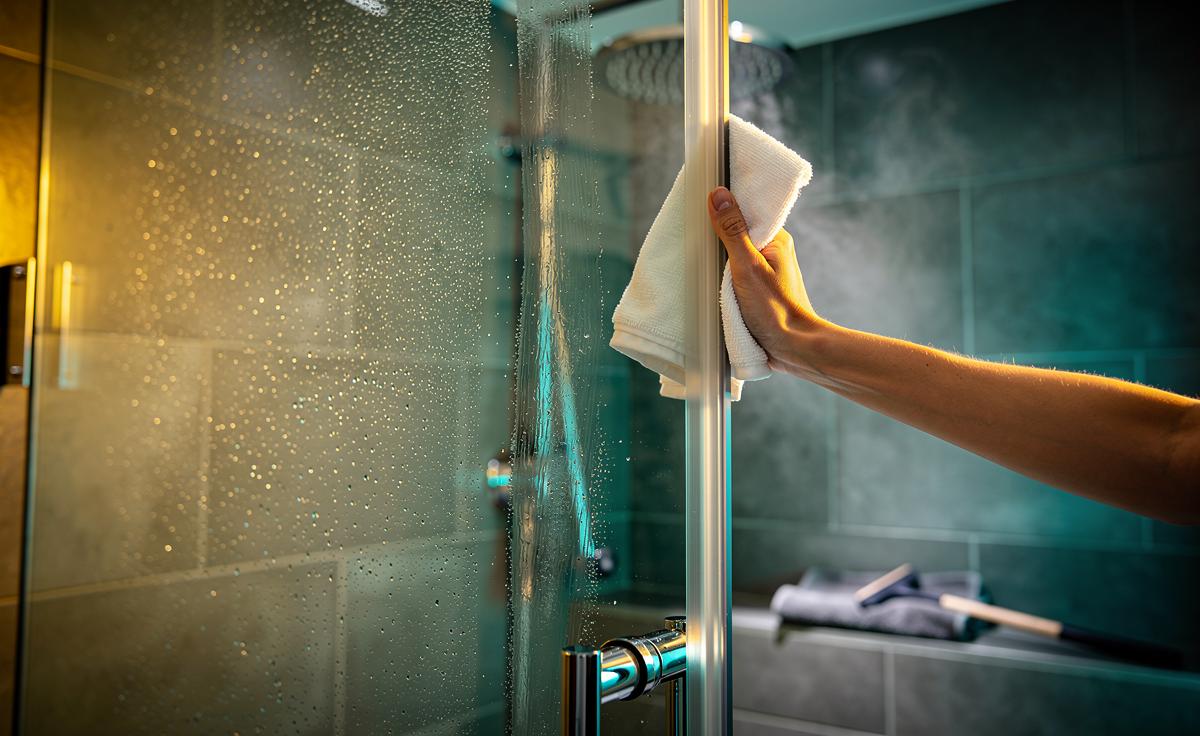
Speed and sequence matter more than muscle. The aim is to remove bulk water fast, then polish off the film that would otherwise anchor scale. Do it immediately after you shut off the shower—while the glass is still warm. Warmth thins the water layer, making absorption faster and streaks less likely. Choose a clean, dry towel with tight weave and intact loops; rough, snagged fibres can shed lint or drag residue across the pane.
Follow this quick pattern for consistency and speed. It sounds fussy; it isn’t. After two or three goes, it’s muscle memory.
- Flick and drain: Shake the screen gently and run the extractor to cut ambient humidity.
- Fold the towel: Into quarters for a cushioned, absorbent pad; swap faces as they dampen.
- Top-to-bottom “S” strokes: Overlap each pass; avoid circular buffing while wet.
- Edge priority: Wipe silicone seals, hinges, and runners—these trap scale first.
- Final polish: Use a drier corner in fast, light passes to lift any film.
If you only have 30 seconds, target the middle pane and bottom edge. That’s where water lingers longest and haze forms earliest.
Pros vs. Cons: Why a Tea Towel Isn’t Always Better (But Often Is)
The tea towel’s power is immediacy and reach: it absorbs as it wipes, and it covers frames, seals, and hardware that squeegees skip. It’s quiet, cheap, and kinder to coatings. Yet it isn’t magic. When the towel is damp, it simply moves moisture around. If your routine lapses for a few days in a very hard-water home, you’ll still need a light descale. And cotton can lint if the weave is loose or the fabric is worn.
Here’s the quick calculus I use on assignment and at home:
- Tea towel, fresh and dry: Best for immediate post-shower drying; excellent on edges and fittings.
- Squeegee: Fast on wide panes but leaves microfilm; pair with a brief towel polish.
- Microfibre cloth: Superior polishing and oil pickup; can smear if saturated.
- Paper towel: Lint-prone, costly, and wasteful; only a stopgap.
- Air-drying or sprays alone: Convenient, but evaporation still cures minerals onto glass.
My rule: squeegee for bulk removal, tea towel to finish, microfibre for weekly sparkle. That layered approach beats any single tool.
Materials Matter: Cotton vs. Microfibre and When to Upgrade
Not all cloth is equal. A traditional cotton tea towel excels at absorption because its loops wick water via capillary action, but it’s average at lifting oils from conditioners and body wash. Microfibre (a polyester–polyamide blend) creates millions of micro hooks that grab both water and grime, making it superb for a final buff. Use cotton for the wet phase, microfibre for the film. If you notice streaks, it’s usually because the cloth is saturated or contaminated with fabric softener—avoid softeners, which coat fibres and nuke absorbency.
Keep one dedicated set for bathrooms, launder hot, and dry thoroughly. Replace when the towel feels “slick” or stops drinking droplets fast—both signs the fibres are coated or broken down.
| Material | Absorbency | Lint Risk | Best Use | Notes |
|---|---|---|---|---|
| Cotton tea towel | High (bulk water) | Low–medium (if worn) | Immediate wipe-down | Avoid fabric softener; fold to keep a dry face |
| Microfibre cloth | Medium–high | Low | Final polish; removing film | Wash separately; no heat softeners or bleach |
| Paper towel | Low | High | Emergency only | Wasteful; can shred when wet |
| Squeegee | N/A (displaces water) | None | Bulk removal on wide panes | Pair with cloth for edges and film |
Case Study: A Simple Home Trial in a Hard-Water Flat
In a rented flat in the South East—classic hard-water territory—I ran a simple comparison for a fortnight. Two adjacent shower panels, same products, same people. After each shower, Panel A got a quick squeegee and a 60-second tea towel pass; Panel B was left to air dry. I skipped all sprays to keep it honest. By week’s end, Panel A still beaded water and looked clear in side light. Panel B showed faint crescents and dotting you could feel with a fingernail—early scale nucleation.
Observations worth keeping:
- Speed beats chemistry: The minute I toweled, haze simply never started.
- Edges tell the truth: Air-dried seals and hinges dulled first; the toweled side stayed clean.
- Less product, less fuss: With the towel routine, I needed only a mild weekly clean, not a harsh descale.
It wasn’t glamorous, but the outcome was obvious to the eye and to the touch. The takeaway: consistency trumps gadgets.
There’s elegance in the ordinary. A tea towel denies minerals and surfactants the drying window they need, preventing cloudy residue before it forms and reducing your reliance on abrasive cleaners. Fold it, wipe top to bottom, finish the edges, and you’ve given your shower screen the equivalent of a daily invisible sealant—with no chemicals or fuss. The best clean is the one you don’t have to do later. Will you try a two-minute post-shower routine this week—and which tool combo (tea towel alone, towel plus squeegee, or towel plus microfibre) do you think will fit your bathroom habits best?
Did you like it?4.6/5 (26)